
How Much Money Does a Cruise Ship Employee Make?
Working on a cruise ship can be one of the most effective ways to save money while traveling the world. Very few jobs pay you to move from country to country, sleep in one city and wake up in another, and eliminate most of your monthly living expenses at the same time. On a cruise ship, your home travels with you — and your commute can be as short as a few minutes from your cabin to your workplace.
One of the biggest advantages of working at sea is that you don’t have the fixed bills you’d normally have on land. Accommodation, meals, utilities, laundry, and medical coverage are typically included. This dramatically changes how your salary should be evaluated and why cruise ship pay often looks low at first glance — but isn’t always low in reality.
Last updated: 2025 — salary ranges, payment systems, and onboarding realities reviewed.
Cruise Ship Salaries Explained: What This Guide Covers
Working on a cruise ship comes with a very different financial reality than a land-based job. In this guide, you’ll learn how cruise ship salaries really work, including typical pay ranges by role, how tips and bonuses factor in, how crew members manage expenses, and how much you can realistically save during a contract.
Why Cruise Ship Salaries Can Be Misleading

Gross Salary vs Real Savings
At first glance, cruise ship salaries may appear low compared to land-based jobs. However, focusing only on gross monthly pay can be misleading. Cruise ship employees live onboard, meaning many major expenses simply don’t exist.
Why Living Expenses Matter More Than Pay
Even before you get to see your money from your land-based job, taxes are taken out of your paycheck and other fees; then come certain fixed bills that most of us have to pay, like:
- Rent
- Water
- Gas
- Electricity
- Car payment
- Insurance
- Phone
- Internet
Here’s why working on a cruise can help you save:
Can You Really Save Money Working on a Cruise Ship?

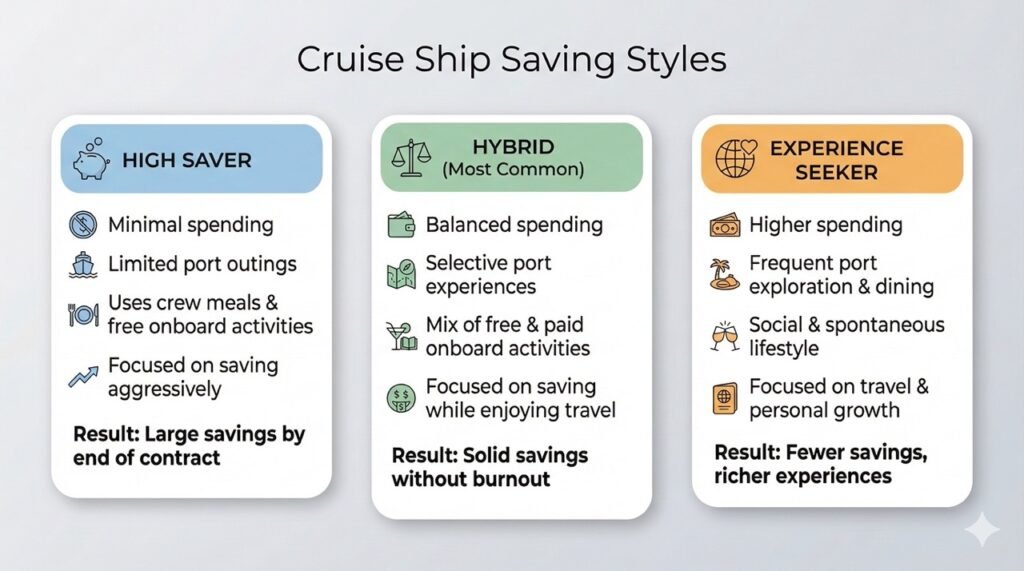
Whether you save a lot of money or very little while working on board often comes down to personal choices. Some crew members aggressively save and invest their earnings, while others prioritize experiences, travel, and enjoying ports of call. Both approaches are valid — and both are common, but the best approach is to have a balanced, hybrid approach to experience the amazing places you will visit while being responsible and saving your hard-earned money as well.
High Savers vs Experience Seekers vs Hybrid Approach
Some people can save a lot of money during their contract on board. I have heard of stories about crew members opening businesses back in their home country, and using the money to buy property; some people made good money that they didn’t have to come back to work on ships. While some people opt for the savings route, others choose to work on ships for the experience. They do not save a lot of money, but they do spend their money in a way that makes them happy and fulfilled most of the time.
The Hybrid Approach (Most Common)
Many crew members adopt a hybrid approach, balancing smart saving with intentional spending. These crew members save consistently onboard but allow themselves a budget for special ports, local food, or meaningful experiences. The draw of cruise ship work is the ability to travel and visit many amazing places. This strategy helps avoid burnout, keeps morale high, and still allows for solid savings by the end of the contract.
Saving Without Sacrificing Fun
Cruise ships offer plenty of low-cost or free activities for crew, including parties, barbecues, themed nights, gyms, and social events. There are a lot of activities catered just for the crew onboard, like crew barbecues, crew parties with free alcohol most of the time, and special themed dinners like Thanksgiving, Halloween, and Christmas, among many other fun activities provided at little to no additional cost for the crew.
By enjoying what’s already available onboard and being selective about spending ashore, many crew members find they can have fun without draining their savings.

Typical Monthly Cruise Ship Salaries by Position

Quick Salary Comparison Table
| Job Category | Example Positions | Monthly Salary Range |
|---|---|---|
| Entry-Level / Service | Housekeeping, Buffet Server, Galley Utility, Dishwasher | $1,200 – $1,800 |
| Hospitality & Bar | Bartender, Waiter, and Assistant. Waiter | $1,500 – $2,500 + tips |
| Entertainment & Guest Services | Cruise Staff, DJ, Youth Counselor | $1,800 – $3,000 |
| Retail & Casino | Retail Associate, Casino Dealer | $1,500 – $3,500 + commission |
| Spa & Wellness | Massage Therapist, Spa Attendant | $1,800 – $3,500 + commission |
| Technical & Marine | Electrician, Engineer | $3,000 – $6,000 |
| Senior Officers | Chief Engineer, Hotel Director | $5,000 – $8,000 |
| Ship Leadership | Cruise Director, Captain | $6,000 – $15,000+ |
Important: Salaries vary by cruise line, ship size, itinerary, nationality, and experience. Tips, commissions, and bonuses are not included unless stated.
Which Positions Pay the Best?
If you’re wondering which jobs pay the most, here are a few high-paying cruise ship positions:
Cruise Ship Captain
As the highest authority on the ship, a captain’s salary can range from $10,000 to $15,000 per month or more, depending on the ship size and the cruise line


Chief Engineer
Responsible for the ship’s mechanical operations, this role commands a salary of $8,000 to $12,000 per month.
Hotel Director
Overseeing the entire hospitality operation on board, hotel directors earn between $5,000 and $8,000 per month.


Entertainment Director: Cruise entertainment is a big part of the experience, and cruise directors can earn between $4,000 and $6,000 per month.
Life as a Cruise Ship Employee
Daily Work Life
So, what’s it really like to live and work on a cruise ship? It’s a mix of hard work, long hours, and exciting opportunities. Working hours can be intense, with shifts often exceeding 10-12 hours a day, depending on your role. However, because your “home” is the ship, you’re always just a short walk away from your room, your meals are prepared for you, and you can even unwind in crew-only areas like bars, gyms, and lounges.
Crew Community & Social Life
The camaraderie among the crew is one of the best parts of the job. You’ll meet people from all over the world and make lifelong friends. The social life on board is vibrant, with crew parties, movie nights, and other events designed just for the employees. Plus, when the ship is docked, you’ll have time to explore new places with your fellow crew members.

A Day in the Life of a Youth Counselor
Want to learn more about what it’s like to work on a cruise ship as a Youth Counselor? Learn why the job of a Youth Counselor is one of the best ones on the ship!
The Reality of Cruise Ship Pay (What People Don’t Always Tell You)
Long Hours & Physical Demands
While working on a cruise ship comes with incredible perks, it’s not for everyone. The hours can be long, the work can be physically demanding, and you’ll spend months away from family and friends. Living in close quarters with other crew members means privacy can be hard to come by, and adjusting to life at sea can be challenging.
That being said, if you love adventure, meeting new people, and don’t mind a fast-paced environment, working on a cruise ship can be an experience like no other.
You Will Not Get Paid While on Vacation

One of the great perks of working on a cruise ship is a long vacation that you get to enjoy. As a rule of thumb, for every month worked, you get one week of vacation. When working on a cruise ship, you are essentially a contractor for the cruise line; you’re not an employee. That means that when your contract ends, so does your pay. You will not get paid until you sign a new contract with the cruise line, and only after the first 30 days of your new contract. Most cruise lines will provide you with the date of your next assignment before you leave your current ship, so you will know when you’ll be returning and to what ship you will be returning to.
How to Budget Between Contracts
You won’t get paid while on vacation, so make sure that you save your money to last your vacation and at least for the first month of your new contract, because again, you’re not going to get paid until the end of your first month onboard. For example, if you have a two-month vacation, you will need to make sure you save enough money to cover your vacation plus enough money to cover your first month back on board. Based on this scenario, you need to save money to last at least three months. It is a horrible feeling when you run out of money during your vacation because that means you’ll be stuck at home with no money to enjoy, and during your next contract onboard, you won’t be able to spend any money because you won’t get paid until the end of the month. Trust me, that happened to me before, and it was not a good experience.
How do Cruise Ship Crew get paid?

Monthly Pay Cycles and Cash Advances
Cruise lines will often pay once a month, on the first business day of the month. You have the option to request a cash advance of up to 50% of your salary to be paid on the 15th of every month. You will receive your full salary plus tips and commission, if you are on a tip or commission salary, at the end of every month.
When I started working on cruise ships, we got paid in cash, which was not an ideal scenario. Walking around the ship with a stash of money made me feel richer but vulnerable at the same time. Going to deposit that money later in the bank was a scary event. Walking around downtown Miami with an envelope full of cash was scary, to say the least.
Crew Pay Cards & Bank Transfers
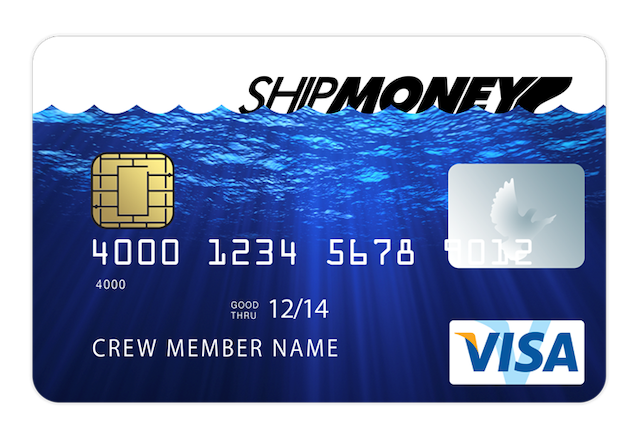
Nowadays, Cruise lines partner with companies that provide the crew members with a prepaid debit card, where the salary is deposited into their account. Depending on the company, the crew gets one free ATM withdrawal a month, and there’s a fee for subsequent withdrawals. You could also transfer money from your prepaid card to a bank account, but depending on the country you’re from, you might have to pay transfer fees. If you have a US bank account, at least with Brightwell (formerly OcenPay), it was free to transfer from your prepaid card to your bank account as long as the account was based in the USA.
Do Cruise Ship Employees Pay Taxes? (Tax Basics to Know Before You Join)
One of the most common — and confusing — questions crew members ask is whether cruise ship income is taxed. The short answer is: it depends on your nationality, tax residency, and how the cruise line processes payroll.
In most cases, cruise lines do not withhold taxes automatically for international crew. However, this changes depending on whether you are a U.S. citizen, a European citizen, or working for a cruise line with payroll obligations in certain countries.
How Taxes Work for Most International Cruise Ship Crew
For many non-U.S. crew members, cruise ship income is not taxed at the source (meaning no taxes are deducted from the paycheck). Tax responsibility is usually determined by your country of citizenship or tax residency, not the country where the ship sails or is registered.
In some countries, income earned while working at sea may qualify for tax exemptions or reduced taxation, especially if you spend most of the year outside your home country. In other cases, cruise ship income must still be declared, even if no tax is ultimately owed.
Important Note for U.S. Citizens Working on Cruise Ships

Most major cruise lines have a corporate or payroll presence in the United States, even if their ships are registered under foreign flags. Because of this, U.S. citizens and permanent residents are subject to U.S. federal income tax on their cruise ship earnings.
In practice, this usually means:
- Cruise lines may withhold federal income tax only from U.S. citizen paychecks
- State taxes are generally not withheld, especially if you are no longer a resident of a specific state
- Social Security and Medicare withholding may vary depending on the contract structure
Even when federal tax is withheld, U.S. citizens are still required to report worldwide income when filing their annual tax return.
Because cruise ship pay structures can vary, it’s important for U.S. crew members to:
- Review pay stubs carefully
- Understand what is (and is not) being withheld
- Plan ahead for any additional tax owed at filing time
Consulting a tax professional familiar with maritime or overseas employment is strongly recommended.
European Cruise Lines and Tax Withholding
Some European-based cruise lines or cruise lines operating under European labor agreements may deduct taxes directly from paychecks for European citizens. This is more common when:
- The cruise line is headquartered in Europe
- The employment contract follows European labor laws
- The crew member is a tax resident of a European country
In these cases, taxes such as income tax or social contributions may be withheld automatically, similar to land-based employment. The exact deductions depend on the country, contract type, and cruise line payroll structure.
Why Crew Should Plan for Taxes in Advance
Because tax treatment varies so widely, many crew members are caught off guard at the end of the year. To avoid stress, it’s wise to:
- Keep records of contracts and monthly earnings
- Understand whether taxes are being withheld from your paycheck
- Set aside savings just in case additional taxes are owed
Even if you ultimately owe little or nothing, being prepared gives you peace of mind while working onboard.
Important Disclaimer
Tax laws vary by country and individual situation and change over time. This section provides general information only and is not tax advice. For guidance specific to your circumstances, always consult a qualified tax professional in your home country.
Traveling With Large Amounts of Cash (CBP Rules)

Declaring More Than $10,000 in Cash
If you are traveling from the USA to your home country and you are carrying over $10,000 in cash, it’s important to declare the money to CBP Customs at the airport before departing. Failure to declare the money may result in it being seized. To avoid this, consider transferring the money to your bank account before you travel, or make sure to carry less than $10,000 in cash with you at all times. The last thing you want on vacation is to have issues right before you go home for your much-needed vacation.

“Failure to declare monetary instruments in amounts valued more than $10,000 can result in its seizure.”
FAQ – Frequently Asked Questions
Below are answers to the most common questions people ask about cruise ship salaries, taxes, and saving money while working at sea.
Yes, cruise ship employees may have tax obligations depending on their nationality, tax residency, and payroll structure. Most cruise lines do not withhold taxes for international crew, but income may still need to be reported in the crew member’s home country. U.S. citizens must report worldwide income, and some European cruise lines may deduct taxes directly from paychecks for European citizens.
Most cruise ship crew members are paid once per month, usually on the first business day of the month. Many cruise lines allow crew to request a mid-month cash advance, typically up to 50% of their salary, with the remaining balance paid at the end of the month.
No. Cruise ship salaries can vary based on job role, experience, contract type, and nationality. While many cruise lines use standardized pay scales, differences may exist due to labor agreements, tax treatment, and local regulations tied to a crew member’s country of residence.
Yes. Cruise ship salaries often increase with rehired contracts, promotions, or moving to higher-responsibility roles. Raises are not automatic but are commonly tied to performance, experience, and career progression within the cruise line.
In many cases, yes. Luxury cruise lines often offer slightly higher base salaries due to higher service expectations, smaller passenger counts, and more demanding roles. However, luxury positions are more competitive and may require prior cruise or hospitality experience.
No. Cruise ship crew members are typically hired on fixed-term contracts and are not paid during vacation periods between contracts. Crew must budget for time off and usually receive their next paycheck only after completing the first month of their new contract.
Most cruise lines pay crew using prepaid debit cards or direct bank transfers. These systems allow crew to withdraw cash, make purchases, or transfer money to personal bank accounts, depending on the provider and country.
Final Verdict: Is a Cruise Ship Salary Worth It?
If you’re passionate about travel, meeting new people, and experiencing life from a fresh perspective, working on a cruise ship could be a fantastic career choice. While the salaries might not seem high compared to land-based jobs, the cost savings and unique benefits often make up for it. You’ll have the chance to explore new destinations, enjoy unique experiences, and, if you’re smart about it, save a decent amount of money.
Remember, a career at sea isn’t just a job—it’s a lifestyle. The friends you’ll make, the places you’ll see, and the stories you’ll collect along the way will likely stay with you for the rest of your life. So, if you’re up for an adventure and ready to embrace life on the high seas, why not set sail on a new career?
“The art is not making money but keeping it”
Proverb